Category Homo Stultus

Welcome to the shallow end of the gene pool—where institutions groan like aging ships, experts strut about in borrowed gravitas, and common sense has been quietly reclassified as a form of extremism. This is the natural habitat of credentialed clowns, procedural necromancers, and moral toddlers somehow entrusted with the fire exits.

The late Italian historian and economist Carlo M. Cipolla once offered a brutally simple taxonomy of the human species. Four categories. Among them lurks the most dangerous creature of all: the idiot. Not the merely foolish, not the ignorant, but the individual who harms others while simultaneously harming himself. Not out of malice. Not even out of classic stupidity. The idiot acts because he has surrendered his mind to a narrative that now operates him like a puppet.

It is tempting—comforting, even—to imagine that the idiots are safely over there, on the other side of some imaginary intellectual border checkpoint, while we ourselves reside in the civilized provinces of rationality. Unfortunately, reality is rarely so courteous. The idiot is not a rare genetic mutation. It is an ancient mental mechanism quietly residing in each of us, like a survival subroutine written long before civilization was compiled.

Out on the steppes, this mechanism served a purpose. Tribal cohesion, narrative loyalty, the instinct to conform to shared myths—these traits helped small groups survive brutal environments. In that world, survival pressure acted as a ruthless quality control system. Narratives that led tribes off cliffs were quickly removed from the gene pool along with their enthusiastic believers.

Modern civilization, however, has achieved the remarkable feat of removing much of that pressure while preserving the instincts it once regulated. And so the ancient idiot survives, comfortable and well-fed, wandering through systems that are now far too complex to tolerate his particular brand of narrative intoxication.

The ancients understood this better than we often pretend to today. For the Romans, the idiot was not necessarily stupid or uneducated. The term pointed instead to a person who was foolish, unreliable, incapable of sound judgment—a man unsuitable for matters of consequence. They had a name for this specimen: Homo Stultus. A creature not defined by ignorance, but by a persistent inability to distinguish reality from the story he prefers to believe.

In this category, we examine the mechanics of that phenomenon—the quiet machinery that produces the common idiot and the far less amusing consequences of allowing such creatures to run the place.

Here you will find a running chronicle of the slow-motion implosion of governance, education, media, and culture. Not written in outrage—outrage is exhausting and rarely useful—but in the dry, almost cheerful tone of someone who saw the trajectory years ago and had the foresight to pack snacks.

There will be no reformist fairy tales here. No therapeutic hand-wringing. Just a front-row seat to the grand theater of the absurd, observed from the balcony, where the view is excellent and the occasional sharp object may or may not be thrown at the stage below.

The Cloak and the Compass
A black cat with glowing yellow eyes emerging from darkness

Most people signal to survive. The Shia called it Taqiyya. Others lived it without a name. Camouflage isn’t weakness—it’s wisdom. This isn’t a sermon. It’s a manual for staying sane in systems built to crush dissent. If you’re quiet, cunning, and still human—you’re not alone. Just hidden. Like the rest of us.


Destruction Is Mercy Now

A demolition excavator tears into the top floor of a partially dismantled apartment building under grey skies.

Systems decay. They don’t reform—they rot. Reform is lip service; demolition brings clarity. Mercy isn’t sparing what’s already poisonous—it’s removing it. Institutions built to serve now serve themselves. When the foundations are hollow, saving them is cruelty. Mercy is the wrecking bar, not the facelift. Mercy is demolition with a conscience.

The Elegy of the Known

Bow of a sailing ship at sea during sunset, heading toward the horizon under an orange sky.

We mourn not what is lost, but what once felt stable. The world we knew - flawed, familiar, navigable - now collapses under a thousand clever lies. This elegy is not for the dead, but for the dependable. For shared meaning. For truth with a pulse. The known is vanishing - and with it, the illusion that we ever understood it.

The Gospel of Less

A single dandelion seed enclosed in a small glass vial with a cork stopper and twine, resting on a dark marble surface with soft, moody lighting.

In an age of noise, subtraction is salvation. The Gospel of Less isn’t about austerity - it’s about clarity. What you strip away, you gain in focus. Fewer things, fewer lies, fewer dependencies. It’s not minimalism - it’s rebellion. A manifesto for those who choose signal over static, and silence over the sermons of a bloated world.

Beauty in the Ashes

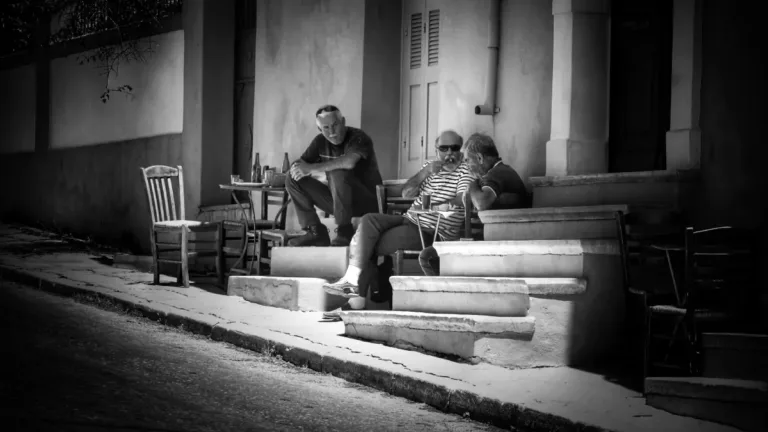
Three elderly men sit on worn steps outside a modest building, talking in the sunlit shade; a few empty chairs and a small table with bottles suggest long, slow conversation.

When the world burns, we’re told to rebuild. But sometimes, the ashes are the lesson. There’s a strange beauty in collapse - in the clarity that ruin brings. What falls away reveals what matters. This isn’t despair - it’s revelation. In the embers of failure, something truer flickers. Not hope. Not healing. Just the unvarnished shape of reality.

Florence from Memory

Close-up of a craftsman’s hands shaping wood with a drawknife, surrounded by fresh shavings.

Florence lingers like a half-remembered dream - stone and shadow, beauty and burden. It’s not the city that changed, but the eyes that see it. Memory edits, distills, betrays. What was once sacred becomes spectral. In tracing old steps, we find not the past, but the echo of who we were when we first arrived.