
Why Humanity Can’t Escape Its Own Biology
Like many others, I am an unapologetic consumer of space news. Podcasts, long-form interviews, grainy launch footage, breathless countdowns, and—towering over it all—the great secular messiah of modern space enthusiasm: SpaceX.
In some sense, I was born into this mythology. I arrived in the year of the Moon landing, barely two months after Neil Armstrong and Buzz Aldrin performed their carefully choreographed ballet on the regolith. That timing matters. It means my childhood was marinated in a steady, almost intravenous drip of space fantasy: Star Trek, Star Wars, Space: 1999, and a small avalanche of illustrated futures showing domed cities on Mars, glassy arcologies on the Moon, and floating habitats hovering delicately above Venus like architectural afterthoughts.
None of this troubled the younger me. I did not ask impolite questions about orbital mechanics, propulsion equations, radiation dosage, bone density loss, logistics chains, or the inconvenient fact that most planetary bodies are actively hostile to human biochemistry. Gravity was assumed. Atmospheres were generous. Temperatures were polite. Every alien world, somehow, had Earth-normal gravity and breathable air, occasionally tinted a fashionable hue for dramatic effect. Aliens, too, were reassuringly humanoid—us, but with forehead prosthetics and mild social quirks.
Popular imagination has always treated spaceflight as a kind of interstellar masquerade ball. The most murderous problems are waved away by technologies that do not exist, have never existed, and in many cases cannot exist even in theory. Spacecraft are sleek, sculpted, and aerodynamic—designed as if Enzo Ferrari himself were subcontracted to decorate the vacuum. Gravity appears courtesy of “gravity generators,” devices whose operational principles are explained with the same rigor as magic rings or warp crystals. Radiation, cosmic distances, and delta-v budgets are politely ignored.
The result is not science fiction so much as engineering fan fiction: a universe where the hard constraints of reality are optional, and inconvenience is a failure of imagination rather than physics.
Collision with Reality
It was only with the rise of the modern commercial space industry—SpaceX, Blue Origin, and their orbiting court—that I began paying attention to what space might actually demand of us. Not what we want from it, but what it will extract in return.
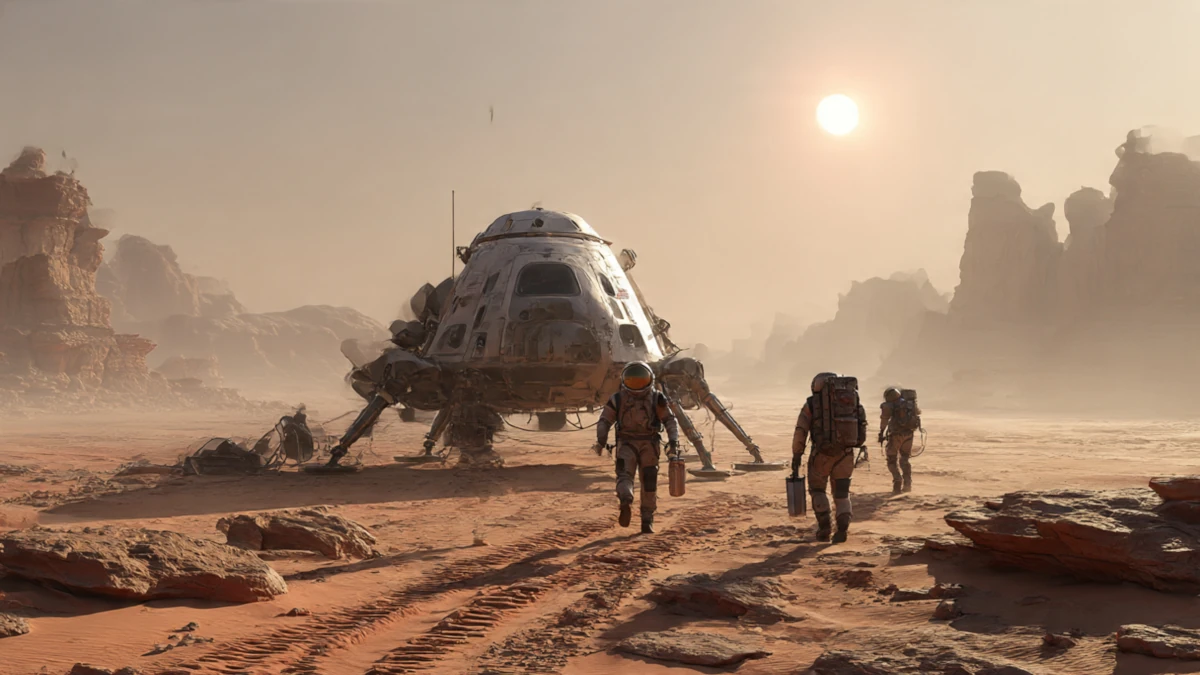
Elon Musk, famously, wants to die on Mars—just not on impact. He speaks of a Mars city with the confidence of a man who has watched far too much space opera and decided to take it literally. His followers repeat the vision with something approaching religious fervor. And yet beneath the slogans and renderings, the idea remains profoundly unserious.
This is not an insult. It is an observation.
Hollywood, to its mild credit, has begun to adjust. Recent depictions—Avatar’s Venture Star, for example—look less like flying sports cars and more like what an engineer might sketch after a long, joyless night with a calculator. The winglets are disappearing. The crocodile silhouettes of Battlestar Galactica have gone extinct. The fantasy has thinned.
But this is surface realism. The deeper assumptions remain untouched: that humans can simply relocate to other worlds and thrive there, provided the rockets are big enough and the will sufficiently optimistic.
They cannot. And they will not.
The Solar System as it actually is
The Solar System is not a stage set. It is a hostile, cluttered, violently indifferent machine.
It consists of one unremarkable yellow dwarf star, eight planets, roughly 890 known moons (about twenty of them large enough to pull themselves into spherical obedience), five officially recognized dwarf planets, thousands of trans-Neptunian objects, and at least a hundred thousand asteroids larger than a kilometer in diameter. Trojan swarms haunt the gas giants. Debris litters every stable orbit.
It is, in other words, a crowded place—if by “crowded” one means “full of things that would kill you.”
If we exclude the Sun, the gas giants, and hellscapes like Venus, and ignore irregular rubble piles, we are still left with perhaps a hundred bodies one could theoretically stand on. The question is not whether there are places to go. The question is whether going there in grand civilizational fashion makes any sense at all.
Cities on Mars. Settlements on Titan. Millions living permanently on moons whose names most people cannot pronounce.
Does this vision survive contact with biology?
Planets are the wrong Target
Earth is the largest and most massive terrestrial planet in the Solar System. That matters. Everything else with a solid surface offers substantially lower gravity. Venus comes closest—and promptly disqualifies itself by being a pressurized acid-soaked furnace.
Human physiology is not gravity-agnostic. Prolonged exposure to low gravity degrades bones, muscles, cardiovascular systems, and possibly developmental biology in ways we do not yet fully understand. On a planetary surface, there is no practical solution. You cannot spin Mars. You cannot dial gravity up. Short visits to centrifuges do not substitute for living, working, and growing under constant load.
Then there is atmosphere, pressure, and temperature. Humans evolved inside an absurdly narrow environmental niche. Step outside it and survival becomes a technological performance, not a natural condition. Mars offers a thin, poisonous atmosphere, lethal radiation exposure, and temperatures that would murder you efficiently. Mercury roasts and freezes. Venus crushes and cooks. Titan seduces with aesthetics—methane seas, orange skies—but would require you to live permanently inside a suit in a place where sunlight is an afterthought.
As Jeff Bezos once remarked, living on Mars would be like living on Mount Everest year-round. That comparison is charitable. On Everest, you can breathe—poorly, but enough to survive. On Mars, unprotected exposure kills you in minutes.
And Mars is one of the friendly options.
What Humans actually are
Here is the uncomfortable truth: humanity is not a spacefaring species. We are an Earth species, exquisitely adapted to a single, improbable planetary configuration.
We require a specific gravity, a particular atmospheric pressure, narrow temperature ranges, liquid water, and a magnetic field shielding us from the Sun’s more homicidal emissions. Remove any one of these and the human animal begins to fail in predictable, ugly ways.
Yes, we can engineer around some constraints. Pressure vessels. Thermal regulation. Radiation shielding. But what we are really describing is not colonization—it is the construction of fragile, artificial Earthlets. Life support systems masquerading as civilizations.
Now consider children.
Adults arriving from Earth carry bodies fully formed under terrestrial conditions. But children born and raised in low gravity, artificial atmospheres, and constrained environments will not develop the way we did. Their skeletons, musculature, cardiovascular systems—possibly even neurological development—may diverge. They may be unable to tolerate Earth gravity. They may become biologically distinct.
That is not a recruitment poster. Colonies that cannot reproduce sustainably are not colonies. They are outposts with expiration dates.
Isolation compounds the problem. On the Moon, Earth hangs in the sky—close enough to haunt you. On Mars, it is a pale dot, an abstract idea. Psychological strain will be immense. Large populations mitigate this, but building large populations takes time—time measured in generations, not funding cycles.
And here we collide with the most underestimated obstacle of all: timelines.
Self-sustaining societies do not appear on command. Even the North American colonies remained tethered to Europe for centuries. Space colonies would be orders of magnitude more complex, fragile, and dependent. Planning for decades is difficult. Planning for centuries borders on fiction. The longer the timeline, the more fat the system requires—and modern institutions are aggressively lean, brittle, and short-sighted.
The Free-Space Alternative
So why struggle on frozen wastelands when we can build habitats designed for us?
In free space, rotating habitats can provide Earth-normal gravity. Atmospheres can be tuned. Radiation shielding can be thick and passive. Temperature can be regulated without apology. Views can be curated. Paradise, engineered rather than discovered.
Mars, Titan, and their kin make sense as research destinations, mining sites, or existential vanity projects. Not as homes for the bulk of humanity.
The Earth–Moon system alone contains absurd amounts of usable space. The Moon orbits roughly 400,000 kilometers away—ten Earth circumferences. Five stable Lagrange points offer locations where massive habitats could hover with minimal station-keeping. Ion thrusters sipping power could maintain position indefinitely.
This volume could house not billions, but trillions. We will never need that capacity. Earth is already drifting toward peak population. Space is not scarce. Comfort is.
Once infrastructure exists, asteroid resources can be brought inward via cyclers. Heavy industry can migrate off-planet. Earth becomes a protected biosphere, not an extraction site.
Economics and Final verdict
There is no serious economic case for planetary settlement. Resources are more abundant, purer, and easier to access in free space. Planets are geologically inconvenient—dense elements sink to unreachable depths, light elements dominate the crust. Asteroids, by contrast, present materials directly, without gravity wells or overburden.
On Earth, we tolerate inefficient mining because we have no alternative. In space, we will.
If we can build vast, comfortable, safe habitats near Earth—and extract resources more efficiently elsewhere—then planets become curiosities, not destinations. Scientific sites. Historical monuments. Occasional retreats for the stubborn and the strange.
Humanity does not belong on planets and moons. It barely belongs on Earth. The urge to smear our neuroses across the Solar System is less a destiny than a failure of imagination.
Better to build our heavens deliberately—artificial, controlled, and honest about what they are. After all, why wrestle with hostile worlds when one can dine comfortably inside the void?