
Why Running Away from Idiots Doesn’t Make You Wise
I have a dream.
It’s a recurring one—uninvited, ungovernable, and oddly seductive. It arrives at irregular intervals, sometimes vanishing for months, sometimes returning three nights in a row as if to remind me that my subconscious has a sense of drama.
In this dream, I can stop time. Not metaphorically—literally. The world freezes, humanity halts mid-gesture, and I’m left standing in a vast, unmoving tableau. Planes hang motionless above the clouds. Conversations are suspended mid-sentence. Even gravity seems to hold its breath. Only I remain awake, wandering through the petrified theater of the living.
There are variations. Sometimes I possess a room—a chamber where time outside stops the moment I enter. Sometimes the ratio shifts: I live 999 days while only a single day passes in the outer world. Everyone else remains asleep, unwakable, while I roam through their dreams of inertia.
No machines function. No screens flicker. The world is silent and inert, mine to observe but not to change. It should feel like a god’s privilege, yet it always carries a faint undertone of dread. Because in every version, I am alone. Not the romantic, wine-and-book kind of alone. The cosmic kind.
Maybe it isn’t about solitude at all. Maybe it’s about control. In a civilization that worships acceleration, the only remaining heresy is stillness. To stop time would be the ultimate rebellion against the tyranny of productivity. The purest luxury would be to waste time without consequence. Yet each time I dream it, the pleasure sours. You can pause the clock, but meaning fades with motion. Eternity, it turns out, is a long time to fill.
If you think that’s eccentric, you’re right. I don’t know if many share this dream, though I suspect a quiet epidemic of people secretly wishing for a world that would just shut up for a minute.
But is it truly strange to crave long stretches of being left alone? Not to escape into the wilderness like some bearded saint of Alaska, but to withdraw mentally from the unending social static of modernity.
Because yes—solitude is becoming a luxury product. And like most luxury products, it’s both misunderstood and misused.
I sometimes do isolate myself in practice. I unplug, vanish, walk for hours without purpose. Being alone and bored is the strongest creative stimulant I know. But boredom is a double-edged drug. It sharpens your mind at first, then starts to eat it. The question isn’t whether solitude works—it’s how long before it turns on you.
Consider Christopher Knight. From 1986 until his arrest in 2013, he lived in the woods of Maine without human contact. Twenty-seven years of chosen exile. He survived by stealing food and supplies from nearby cabins, an invisible parasite feeding off civilization while pretending to reject it. When he was caught, he said that solitude had heightened his perception of the world but eroded his sense of self. Without an audience, he no longer knew who he was.
Now contrast him with Richard Proenneke, who retreated to the Alaskan wilderness at fifty-two. He wasn’t escaping people—he was escaping clutter. He built his cabin, filmed his work, and wrote journals that turned into one of the finest meditations on self-reliance ever recorded. No theft, no shame, no fantasy. Just deliberate simplicity and iron discipline.
Knight fled because he lacked an inner compass. Proenneke thrived because he possessed one. Solitude didn’t make them what they were—it amplified what they brought into it.
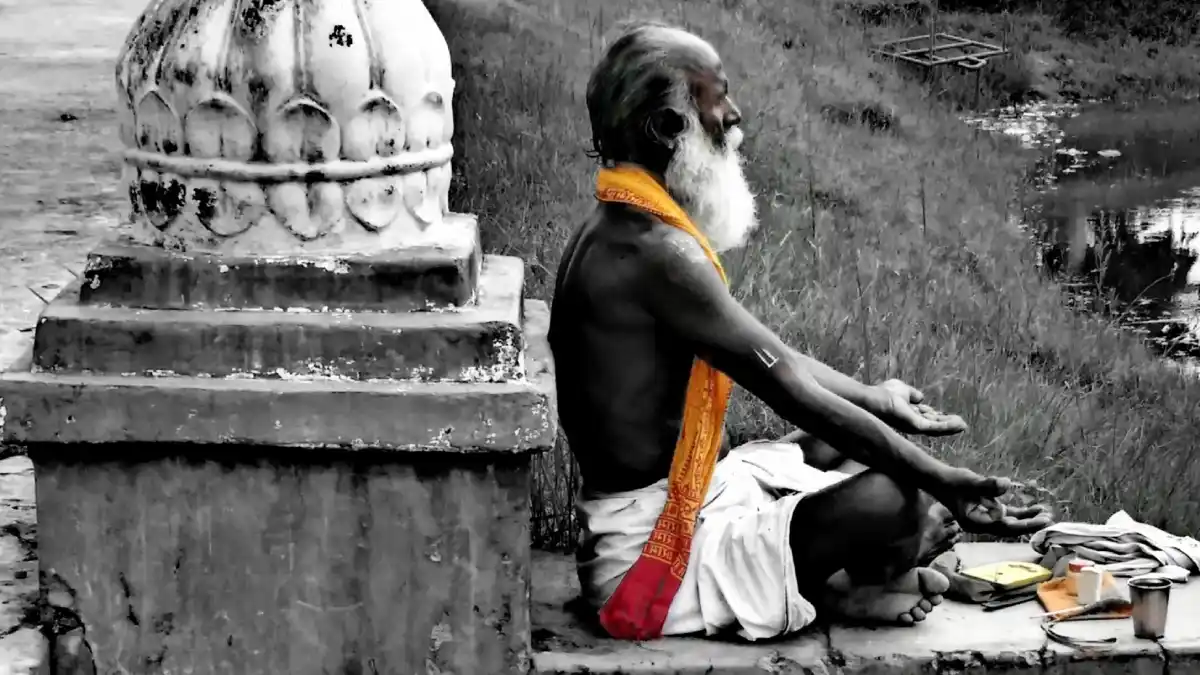
The hermit, in the end, is civilization’s mirror. He reflects its sickness by stepping out of it. But most mirrors crack. The forest doesn’t cure you. The desert doesn’t absolve you. Solitude strips you down to your raw materials—and if those materials are confusion, guilt, or weakness, you’ll meet them all in high definition. Civilization hides your fractures; isolation lets you hear the sound of your own breaking.
Religion, of course, industrialized this process long before self-help influencers discovered it. Think of Saint Simeon Stylites the Elder, who spent decades atop a column in Syria, baking under the sun, battered by wind and prayer. The man turned solitude into architecture.
Such ascetics didn’t start there. They were trained for it—monastic life was their boot camp. The monastery wasn’t a retreat; it was a laboratory where men prepared to confront the divine silence. That’s the forgotten function of those cloisters: not isolation from life, but exposure to it in its purest, most unbearable form.
Solitude, like fire, is neither good nor evil. It magnifies. It’s the amplifier of whatever signal you feed it. Garbage in, garbage out—only louder. Bring steel and conviction, and solitude will temper you. Bring weakness, and it will melt you into a puddle of despair.
Brendan Grimshaw, the man who turned a rocky Seychelles island into a private paradise, understood this. He didn’t flee humanity in disgust; he simply found a better use for his hours. Solitude, for him, wasn’t rejection but refinement.
The modern misunderstanding of solitude is the belief that it’s a solution. It isn’t. It’s a test.
And yet, our era breeds a peculiar pathology: the fetish of isolation.
We live in a time where even withdrawal must be performative. The “digital monk” livestreams his detox. The influencer takes a selfie of his “offline life.” Solitude has become a brand. These people don’t seek silence—they crave a quieter applause.
They retreat from society but drag the camera crew with them. They build YouTube monasteries and call them “minimalist lifestyles.” It’s cowardice with filters, narcissism in hiking boots. The true hermit doesn’t announce his departure. He just disappears—and stays gone.
No, you should not become a hermit. That’s not Stoicism. That’s surrender in a robe. The Stoic doesn’t flee from fools; he walks among them untouched. I live in central Vienna—loud, neurotic, self-advertising Vienna—surrounded by egos and performative stupidity. And I’m fine. Thriving, even.
I post online. I argue. I provoke. I get praised, mocked, misread. I enjoy all of it. You know why? Because I’ve learned that being offended is a personal defect, not a social injustice. If you can’t walk through a world of fools without losing your composure, that’s not enlightenment you need—it’s spine.
The trick isn’t to run from idiots. It’s to render them irrelevant.
You don’t fix the crowd. You fix your filters. You don’t fight noise with noise—you refine your frequency until the static fades. Most people are just bandwidth pollution. Treat them as such.
Detachment is not apathy; it’s marksmanship. You pick your targets carefully. A few rules help:
- You don’t owe anyone access to your mind.
- When everyone’s shouting, silence is a weapon.
- Never debate those whose self-worth depends on winning. Let them win; you lose nothing.
- Withdraw without sulking. Disengage without drama. Smile while they scream.
That’s the art of civilized indifference. You don’t need a monastery for that—just composure.
Not everyone can go fully rogue. Some have jobs, bosses, mortgages, reputations. Fine. That’s camouflage. You act bland so predators don’t bite. You wear the mask but never forget it’s a mask. That isn’t hypocrisy—it’s survival. Civilization is theater; the wise play their parts without believing the script.
I can swim in a cesspool without taking on the stink. You can too, if you train for it. Not spiritually—practically. The goal is simple: remain uncorrupted in the midst of absurdity.
When the circus gets unbearable, leave. Quietly. No grand farewell, no manifesto. Just vanish. Reappear where things make sense—or where the noise can’t reach you. You owe the mob nothing.
I learned this long before the internet existed.
When I worked as a Blue Helmet in Syria in the 1990s, we’d get occasional leave—five or six days at a time. The others made a beeline for Israel: Netanya, Tel Aviv, Eilat. Sun, sand, booze, and bad decisions. I tried it once. That was enough.
Instead, I spent my breaks in the desert—hiking wadis, climbing cliffs, sleeping under an indifferent sky. Days of silence, no human voices except the occasional wind muttering through the rocks. When I returned, I was always sharper. The desert doesn’t flatter you; it sandblasts you down to essentials.
Later, when I crossed Egypt by bicycle, I followed the long crescent of oases from Fayoum to Farafra, Dakhla, and Kharga. Ten days of near-total solitude. The sun dictated my schedule. Water dictated my route. Silence dictated my thoughts. The absence of chatter was intoxicating. I realized that solitude isn’t the absence of company—it’s the restoration of proportion.
The desert has its own arithmetic of time. Days stretch like continents. You stop measuring hours and start measuring shadows. Every sound becomes significant: the creak of metal, the hiss of wind, the pulse in your skull. That’s the closest I’ve come to my recurring dream—time suspended, the universe politely stepping aside so I could catch up.
When you’ve lived inside that kind of silence, you return to civilization with a new immunity. The noise no longer penetrates. You can stand in the center of a city and still feel the desert breathing in your chest. That’s solitude’s real gift: not escape, but endurance.
Engage with the world, yes—but on your own terms. Toy with it. Observe it. Laugh at it if you must. Just never let the clowns recruit you into the act. The machine is idiotic, but playing with it consciously is a kind of art. You can do that anywhere—in the wilderness, on a pillar, on a bicycle, or in a subway crowd. Geography is irrelevant. The only real border is mental.
Christopher Knight hid from humanity and went blind to it. He didn’t learn to filter; he just unplugged the socket. His solitude had no structure, no purpose, no legacy—only avoidance. That’s not enlightenment. That’s emotional bankruptcy with good camouflage.
The fantasy that isolation equals purity is one of our age’s prettier lies. It flatters the ego by pretending withdrawal is wisdom. It isn’t. It’s just a quieter form of vanity.
I sometimes think my recurring dream is less a fantasy than a warning. To freeze the world, to silence it completely—that’s not peace. That’s death rehearsed. What I actually crave, perhaps, isn’t the stoppage of time but the stillness of mind within it.
Maybe the dream is teaching me presence: how to stand still while everything else moves, how to hold my shape when the current pulls. The goal isn’t to stop the world. It’s to move through it so cleanly that it leaves no residue.So no, I won’t become a hermit. I’ll stay here, in the noise, unamused but unbroken.
The world will keep spinning, the fools will keep shouting, and I’ll keep walking—untouched, unmoved, and, most of all, awake.