
On privilege, poverty, and the grotesque miscounting of stolen dreams
We like to talk about children in the abstract. Innocence. Potential. The future. It allows us to feel concerned without having to be precise.
So let us be precise.
Roughly 24% of the world’s population are children—just under two billion human beings. They do not, despite what sentimental posters and NGO brochures imply, grow up under anything resembling equal circumstances.
According to the UN, some 820 million people live under the constant threat of severe malnourishment. Children are always first in line when scarcity sharpens its knives. Roughly 3.1 million of them die each year from the consequences of calorie deficiency alone. That number is obscene enough, but it is also misleading, because it only counts the clean, final outcome: death. Beneath that visible peak lies a much larger, uglier mass. Children who do not quite die, but who are permanently damaged. Immune systems so weak that a mild infection becomes a death sentence. Bodies that never grow to their intended size. Brains starved of the raw materials required to fully form. Malformations. Cognitive impairment. A grim catalogue of vitamin-deficiency diseases that read like relics from a 19th‑century medical textbook, yet stubbornly persist in the present tense.
This post first appeared in 2019, back when I still entertained hope that rational arguments might sway public sentiment. I’ve since remastered it—sharpened the edges, clarified the threat, and realigned it with the Grimwright ethos: use what works, discard the rest, and always—always—question the narrative. The date remains unchanged as a historical marker. The content does not.
In 2014, around 60 million primary-school-aged children were not in school at all. Half of them lived in Africa. Even in so-called developed countries, plenty of children do not eat enough. This is not some fashionable fasting experiment or dietary ideology. It is deprivation, plain and unromantic. Many of these children grow up in conditions that would make our moral speeches about equality blush with embarrassment.
What I am describing here is the bottom of the barrel. The part people prefer not to look at for too long, because it complicates tidy narratives. It is easy—and emotionally convenient—to assume that all other children are essentially fine, or at least roughly comparable in their living conditions. Nothing could be further from the truth. Even among those not scraping the absolute floor, differences can be dramatic.
Like almost everything else worth understanding, the living conditions of children form a spectrum. Imagine it numbered from 0 to 100. Zero represents the most abject conditions the human mind can reasonably imagine: a child hovering at the edge of starvation in the Sahel, or growing up in a war zone where nutrition is a luxury and shelter a temporary rumor. One hundred represents the opposite extreme: the life of a billionaire’s child, capable of indulging every whim, surrounded by bodyguards, private tutors, and constant motion—jet-setting between continents, rubbing shoulders with the rich and beautiful, cocooned from friction by money and power.
The vast majority of children accumulate in a massive bulge somewhere near the center of this curve. They have broadly similar access to food, healthcare, parental care, and education. Their lives are not identical, but the baseline is recognizable. They also possess something else: plausible life potential. By any honest accounting, middle-class European children would not sit anywhere near the true midpoint of this spectrum. They cluster far closer to the billionaire child than to the starving one. They may not enjoy yachts and private islands, but they live remarkably sheltered, comfortable lives with excellent prospects—assuming, of course, that they do not actively sabotage themselves.
The actual midpoint would more likely be occupied by a child in an average Indian or Egyptian family, or similar societies. Not coddled to the same degree as European or North American children, but living in relative safety, with enough decent food and a future that is not foreclosed by default. Not paradise. Not hell. Something in between.
The numbers thin out sharply toward both ends of the spectrum. At the top, the thinning is extreme. Truly rich children are rare. At the bottom, the same applies: the utterly destitute are fewer than our imaginations sometimes assume. But here is the crucial point people like to miss: rarity does not imply irrelevance.
Let’s look at the numbers again. About 3.1 million children die of hunger every year. Compared to two billion, that is a small percentage. It tempts the complacent to conclude that the other 99.7% are doing just fine. They are not. Many of them live one missed harvest, one sick parent, one regional conflict away from catastrophe. Others exist slightly above that threshold—technically alive, practically precarious.
On the richer side, even being near the top one percent does not automatically translate into a life of grotesque excess. Wealth, like poverty, comes in layers.
I grew up in the Austrian countryside. I was safe. I trusted—correctly—that my parents would cover my basic needs. I went to school, and later even to university, without ever knowing what real hunger feels like. I did not always wear the latest fashionable nonsense, but I was properly dressed. My shoes fit and did their job. I owned a very good bicycle. I had all the stationery school required. My parents worked hard to provide these things, in part because we were seven children, which is already an eccentricity where I come from.
By global standards, this upbringing borders on the obscene. A child in Ethiopia or Bangladesh would reasonably consider it unimaginable luxury—and here I am not even talking about the poorest of the poor, but about average families in those countries.
By any sober measure, I belonged to roughly the ten percent luckiest children on Earth.
Was it all a pony ride? Of course not.
Despite having solid middle-class parents, we were still far removed from what one would call the upper crust of society—even locally. There were rich kids. There were also children whose parents were not wealthy but still noticeably better off than mine. The gradations were obvious, even then.
Many people today persist in a childishly simple worldview: there are the poor, and there are the rich. Reality is messier, layered, and far less comforting. Between those extremes lie countless gradients. Even among the so-called rich, differences are stark. The same applies at the bottom.
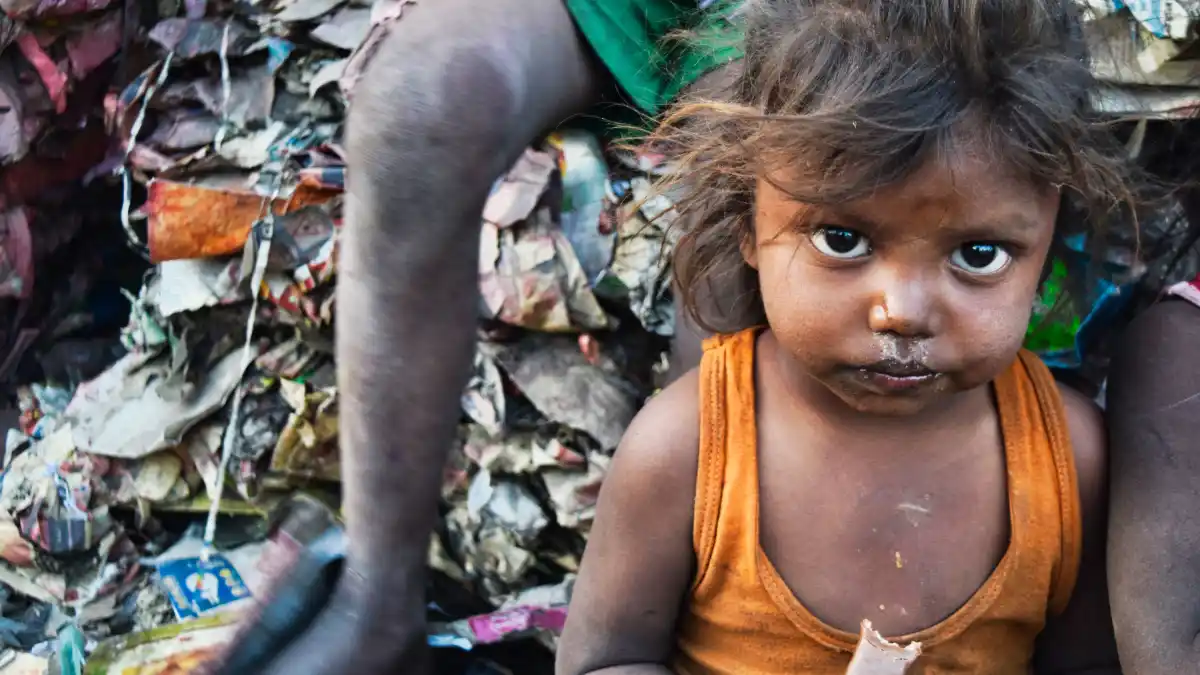
An upper-middle-class child in Germany lives extraordinarily well, yet cannot meaningfully compare their life to that of a billionaire’s child in Silicon Valley or a nouveau-riche heir in Dubai. Likewise, the deeply poor are not a monolith. During my travels in Africa, I encountered severe poverty—but most were not destitute in the way the garbage-collecting children of Cairo are destitute. Poverty, like wealth, has strata shaped by geography, infrastructure, and political stability.
This is not new. It was no different forty years ago.
There are vast numbers of children who go hungry every single day. Many never attend school. Others must work under grueling conditions simply to keep their families afloat. Girls are sold into brothels in parts of Asia at the age of ten. Street children sniff glue under bridges in Manila to dull hunger and make reality tolerable. Child slaves dig rare metals out of the earth—metals upon which our fashionable green technologies depend—hands blistered, lungs poisoned, skin burned by chemicals and neglect.
The life of a child in the coltan mines of the Congo bears no resemblance whatsoever to that of a Swedish schoolgirl. What dreams is such a child allowed to have? What dreams are even conceivable?
What dreams can girls in Sudan have who walk miles each day to fetch water for their families? What dreams can a child soldier in the Central African bush entertain? What dreams belong to brothel girls in Asia, where child prostitution is routine rather than shocking? What dreams flicker, if any, in the minds of street children in Cairo, or those living in the sewers of Ulaanbaatar?
And then we are presented with a sixteen-year-old girl on a global stage, framed by the rich, famous, and powerful. She lives among the absolute top sliver of humanity. She enjoys luxuries that even middle-class children can barely imagine. She is transported across oceans on racing yachts made of exotic polymers affordable only to millionaires. She is chauffeured to exclusive gatherings, sleeps in the most expensive hotels, eats from plates that cost more than some families earn in a year. And she speaks of her stolen dreams.
And we listen.
We listen as if our lives depend on it. As if some profound moral revelation is unfolding. But what can she possibly know of life in any meaningful sense? What dreams has she been forced to abandon? She is living a version of existence that 99.9% of all children will never even approach.
In my early twenties, I once wandered into a tattoo shop in Los Angeles and struck up a conversation with a sixteen-year-old girl. At some point she mentioned wanting a tongue piercing. I asked—genuinely curious—why anyone would want to punch a hole through their tongue. She told me it was the only thing left that still gave her a thrill. She had already seen everything else.
I was speechless. She had barely ventured beyond a two-hundred-mile radius of Los Angeles. What kind of distortion had produced this boredom? What could she possibly have experienced that compares, even remotely, to the life of a child soldier who never had the luxury of imagining something better?
Now we are offered another sixteen-year-old. One who has lived like a film star for years. She mingles with celebrities and royalty. She attends elite events, receives lavish gifts, and is all but guaranteed a billionaire lifestyle. She occupies the top 0.1% of humanity.
She has everything—except, we are told, her dreams. Those were stolen. By us. Because we supposedly destroyed the world she expected to live in.
But what world did she imagine? What world was she ever entitled to expect?
My generation grew up under the constant threat of global thermonuclear war. We lived with acid rain, with Chernobyl, with asbestos, with toxic toys and poisonous paint. And I say this as someone who was still among the lucky ten percent—not a garbage child in Cairo, not a scavenger on the electronics dumps of Ghana.
Let me ask a simple question.
Did you seriously believe that humans were destined to live in harmonious balance with Earth and nature? If so, allow me to disappoint you. Earth is a harsh, indifferent planet. It has wiped out vast swathes of life repeatedly, without hesitation or sentiment. We call these extinction events today, as if a label somehow softens the fact.
Nature does not care about us. The planet does not care about life. If a cosmic event sterilized Earth tomorrow, the rock would not shed a single tear. Life has always been a struggle against the elements. Ironically, living conditions were arguably better during the late Jurassic than at any point since. The last couple of million years have been comparatively hostile.
Earth is not some immaculate pearl designed for balance and harmony. It is what it is. Human impact is part of its ongoing evolution. There are forces we cannot meaningfully control—plate tectonics, solar activity, cosmic randomness. Pretending otherwise is childish.
But there are things we can change. They exist here, on Earth, and they involve the dreams of children whose ambitions are modest to the point of heartbreak. A full stomach. Survival. Parents who return home. The chance to attend school. A life that includes safety, daily food, and the hope that their own children might reach adulthood.
Those dreams require economic development. And economic development, inconveniently for the sentimental, requires stable, reliable, affordable energy. Not boutique solutions designed for wealthy societies to feel virtuous, but energy that actually works at scale. The kind that runs hospitals, purifies water, powers industry, and keeps food from rotting in the dark. For now—and for the foreseeable future—that means fossil fuels. Life energy.
Everything else is luxury ethics.
I do not care if a rich child throws a tantrum because her internal pony rides turned out less colorful than promised. I do not care if her carefully curated sense of doom feels existentially authentic to her. Not when millions of children still die quietly every year. Not when millions more survive just long enough to be stunted, weakened, and robbed of even the possibility of choice.
Dreams are not stolen from those who never had to fight for survival. Dreams are stolen from children whose only ambition is to eat tomorrow, to live through the week, to see their parents come home alive. Every policy that makes energy scarcer, development slower, and poverty more permanent steals from them directly.
What we are witnessing is not moral awakening, but moral inversion. The anxieties of the safest, richest children on Earth are elevated to universal tragedy, while the slow, grinding destruction of the poor is reclassified as an acceptable cost. This is not compassion. It is narcissism with a microphone.
If we are going to speak about stolen dreams, let us at least have the decency to count them properly. And if that arithmetic offends those who have never known hunger, danger, or restraint, so be it. Reality does not owe the comfortable a bedtime story.